Archive for the 'accessible design' Category
Thursday, July 28th, 2011

Changing eyesight is one of the first signs of aging, and typically begins around 45-years of age, according to optometrists. Changes include loss of ability to see far away or up close, reduced contrast sensitivity, and increased sensitivity to glare.
Simple improvements can be made in your home to work with your changing eye sight. These changes are recommended to keep you safe and productive in the home you love.

LIGHTING
Scientifically, 60-year old eyes need twice as much light as 30-year old eyes. Areas of improvement include:
• Increase the wattage of all light bulbs in your home
• Switch from incandescent to cooler compact fluorescent lighting
• Add lighting to all indoor stairwells
• Light up outdoor walkways as well as entries
• Install under-cabinet and task lighting in the kitchen
• Install lights in all closets

CONTRAST
Aging eyes lose the ability to see mild contrast in colors, tone and textures. Ways to work around this include:
• Make stair steps a different color than the surrounding area
• Place colored strip on the edge of each step to see it clearly
• Install color borders around floors and countertop edges
• Vary flooring between dark and light colors as the surface changes
• Contrast the colors between walls and floors

GLARE
Too much contrast between dark and light can be temporarily blinding. The goal is to increase the overall brightness level in a consistent manner. Steps to reduce glare include:
• Switch to a matte finish for wall paint, flooring and countertops
• Use non-glare glass on framed art work
• Adjust floor lamp locations to behind and slightly right of where you sit
• Adjust lamp shades so bottoms are at your eye level
• Aim some lights toward walls and ceiling to create ambient light
These are relatively easy adjustments to make around your home that reap immediate benefits for your mobility and safety. To learn about other accessible design techniques, or for assistance in remodeling your home for accessibility, call the certified aging in-place specialists at Mosby Building Arts at 314.909.1800 or contact them here.
Posted in accessible design | No Comments »
Thursday, July 21st, 2011
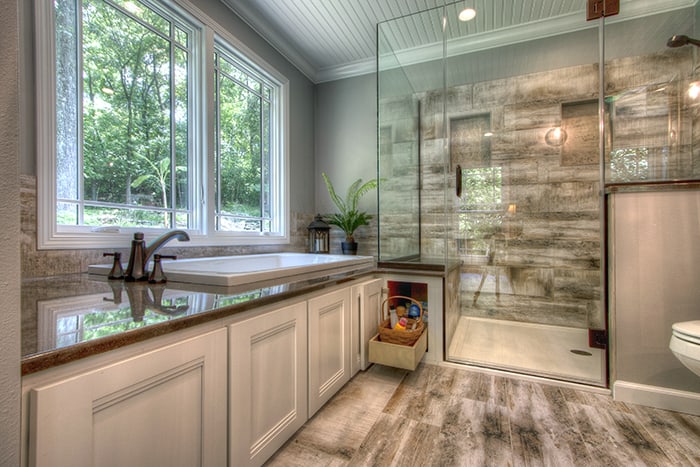
The bathroom can be the first room to highlight decreasing mobility as we age. This is because it’s a room equipped for a wide range of purpose and movements. Should your bathroom present new challenges, an accessible bathroom canl increase your freedom and independence. Here is an introduction to some of the most useful accessibility features for the bathroom:

GRAB BARS
Bathrooms require much physical activity – sitting, standing and moving about on wet surfaces. All of these activities are easier and safer with grab bars.
Place grab bars next to toilets, and inside and next to bath tubs and showers. And they are now as beautiful as they are functional. Many bathroom lines now include grab bars with other bathroom accessories like towel racks and robe hooks, so they come in a large array of styles and finishes.

COMFORT-HEIGHT TOILETS
Make it easier to raise and lower yourself onto a toilet by increasing its height. Standard toilet height is 14 – 15” inches above the finished floor, while comfort-height toilets are 17 – 19” high. Those extra 3 – 5” inches of height can make a big difference with your knees, legs and balance.
Comfort-height toilets are quickly becoming a standard feature because they just make good sense, and now come in a wide variety of styles and colors to coordinate with most any bathroom interior design.

ROLL-UNDER SINK & VANITY
Clear floor space under a sink and vanity countertop creates room for a wheelchair, bench or chair. The recommended height for accessing a sink while seated is 34” maximum from the top of the counter to the floor, which needs a minimum clearance of 29” from the underside of the sink to the floor.
There is also the option of an adjustable sink that can be raised and lowered to the best height for the person using it. It can be operated manually or electronically with a remote control.

FAUCETS
Limited dexterity in your hands can easily be overcome with new sink fixtures. Single lever faucets operate with one hand and make it simple to adjust flow and temperature without using your fingers or wrist. There are also electronic faucets with sensors that detect when it’s time to turn the water off and on. They are very similar to ones you may have encountered in public restrooms, and while they are a bit more expensive, their total ease of use and water-saving efficiency makes them a good long-term investment.

LIGHTING
Aging eyes need plenty of light, so consider both overhead and task lighting for specific areas. Shower interiors with no windows can get pretty dark, which is a safety hazard; a waterproof light fixture inside the shower stall or above a tub and shower enclosure takes care of this problem.
Also keep in mind the light switches themselves. Moving switches to a lower spot on the wall makes them easy to reach from a seated position, and rocker-style switches make it simple to operate lights with the simple touch of a finger.

ACCESSIBLE SHOWERS
Removing the obstacle to getting into the shower is the goal of low-clearance or no-clearance shower. The roll-in version usually has three walls with one open side so a wheelchair can glide in, and the floor is sloped toward a drain flush with the surface. The walk-in version is essentially a four-sided box with a low-clearance threshold under the door.

BENCH SEATING
An important aspect of an accessible shower is a place to sit. For tighter spaces, a retractable bench can be mounted to the wall so it’s not in the way when not in use. If you’re opting for a complete remodel for an accessible shower, a built-in bench is a great option that benefits everyone who uses the shower.

HANDHELD SHOWERHEAD
Also known as hand showers, they have a hose attached to them so they can be removed from the wall and held in your hand. Some models are attached to a vertical bar so the height of the spigot can be adjusted for sitting or standing when used as a wall mount.
This is just a sample of the features that are available when remodeling your bathroom for accessibility. The Certified Aging In-Place Specialists (CAPS) at Mosby Building Arts are deeply experienced in accessible design (see their projects here) and will work with you on what options will be right for converting your bathroom for mobility. For ease of use in your bathroom, call the Mosby office at 314.909.1800 or contact them here.
Posted in accessible design | No Comments »
Thursday, July 14th, 2011

As you get older, things you once barely paid attention to can suddenly have a spotlight shining on them. If you’ve noticed that taking the stairs now wears on your feet or knees, that might be a sign that your abilities are changing. But it also may highlight just how many times a day we take the stairs.
Picture a typical 2-story home with a basement in Metro St. Louis. We traditionally install the washer and dryer in the basement while the bedrooms are on the top floor of the house. Washing laundry could easily have you running up and down 2 flights of stairs multiple times in one day. And that’s just for laundry – how many other times a day do you take the stairs?
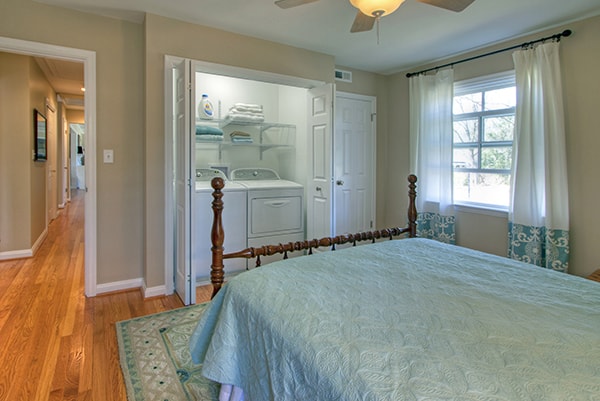
Even a one-story ranch house with a basement has you up and down the stairs on a regular basis, and older knees really start to notice. This is why relocating the washer and dryer to the main level of the home has become a popular accessible design project.
If you already live in the highly adaptable, classic ranch-style house, then your master suite is already on the same level as the public spaces of the home. Moving the washer and dryer up from the basement will greatly reduce the number of times you need to take the stairs.

If you live in a multi-story home and the stairs have become an issue, consider relocating your master suite and the laundry to the main floor of your home. Then you’d have everything you need on a single-level, making your home much easier to navigate.
It is entirely possible to reconfigure the existing spaces in your home to give you the single-level living that makes life easier. By working with a certified accessible designer, you will discover how to convert under-utilized spaces like dining rooms or formal living rooms into a master suite, and find the places to hook up a washer and dryer – maybe even in the new master suite!
Challenges can lead to solutions. The Certified Aging In-Place Specialists at Mosby Building Arts work with you to find the solutions that let you age gracefully in a home you love. If single-level living is an option you’d like to explore, call the Mosby office at 314.909.1800 or contact them here.
Posted in accessible design | No Comments »
Thursday, July 7th, 2011

Planning now for the future in your home is a wise move, and it can also bring benefits when the unexpected happens. No one knows this better than Jean Leonhardt of Ballwin, MO. She was featured in a recent issue of the Angie’s List subscriber magazine (read it here) because her story of an aging in-place remodel has an interesting twist.
Her accessible design project (see pictures of it here) was originally inspired by a growing need for laundry to be on the main level of her home to cut down on trips up and down the stairs. As she talked about her home with a Certified Aging In-Place Specialist (CAPS) it was discovered that – while she had no immediate mobility needs – she never wanted to be in a position where she couldn’t tend to her gardens or enjoy her beautiful backyard.
Jean is unique when it comes to thinking in advance about the years ahead. She knows she wants to always stay in the home she loves, and learned that incorporating accessible design features into the remodel of her home would not compromise the look or the budget of the project. She would have everything in place now and be ready for whatever the future brings.
For 3 years, Jean has used and enjoyed all the new features of her home, and didn’t think of them as accessible, but rather as details that make life easier in her remodeled home. Then an unexpected event changed everything.
In January, she slipped on ice and broke her leg, forcing her to use a wheelchair or walker to get around. Suddenly, all the accessibility details incorporated into her remodel were very much needed, and made a real difference during a difficult time. The wider and shallower set of stairs from her garage to the room addition allowed her to still access her car. The wheelchair and walker slipped easily through all the widened doorways with low-clearance thresholds. She could still access her washer, dryer and utility sink while seated in the wheelchair. And she could glide out onto her patio or sit in the sun room without a second thought.

As Jean said to the Angie’s List writer, “Everything was in place that I didn’t know I’d need before the accident!” Which highlighted that accessibility is not just about aging, but about remaining independent and mobile under all circumstances at any age. The same accessible features that have helped her while mending from a broken leg would also help a young man on crutches from a sports injury or a mother with a baby stroller.
It just makes good sense to incorporate accessible design into every home because it benefits everyone of all ages, and because you never know when any member of your family will become incapacitated or require ease of use.
Mosby Building Arts is the firm Jean Leonhardt worked with on her remodel, and when Scott Mosby came to her home to discuss moving the laundry up to the first floor, she had the good fortune of working with the original, national CAPS ambassador. Together they made a plan for her future, and the Mosby planners, designers and carpenters brought that plan to life.
Learn more about Mosby’s accessible design services, and to make your home accessible both now and for the future, call the Mosby office at 314.909.1800 or contact them here.
Posted in accessible design | No Comments »
Thursday, June 30th, 2011

There often comes a time when your home doesn’t seem as friendly as it used to be. The staircases can feel like mountain climbing and stepping in and out of the shower becomes an obstacle course. You’ve changed while the house has stayed the same.
When this happens, a common thought is to sell the home and move to a retirement community that is more accommodating to an aging lifestyle. But what if the home you already love could change along with you?
Just as homes are remodeled to handle a growing family in the early years, it can again be remodeled to work with your changing abilities in the later years. This concept is known as aging in-place, with architects and designers becoming certified in a form of accessible design that gives the maturing Baby Boom generation the freedom of modifying homes to work with their changing lifestyles.
Accessible design is solution-based remodeling. For example, climbing the stairs to get to your master bedroom upstairs or the laundry in the basement can be hard on older legs. Moving your master suite and laundry to the main floor of the house removes the stair-climbing issue. This is possible by re-configuring the floorplan to convert spaces no longer used as much as they once were into the places you need to use every day.

Your master bathroom is another key accessible design area. Converting a tub with shower into a walk-in shower with bench seating and handheld shower head transforms an obstacle into an asset that is just as functional as it is beautiful.
When Is Accessible Design Right for You?
There are important factors to weigh when deciding if you should stay in your current home or move to a retirement community:
• If you love your current home, the neighborhood and the community amenities you’re familiar with, it may be better for your peace of mind and happiness to modify rather than relocate.
• If you’re free – or nearly free – of monthly mortgage payments, it may be more cost effective to remodel for accessibility than incur the expense of moving and taking on a monthly lease or new mortgage.
• If you’re already contemplating remodeling a home you plan to stay in, incorporating accessibility features now can help you benefit from this investment for an even longer period of time.
• If you’re wondering how accessible features will affect re-sale value, you can learn from a Certified Aging In-Place Specialist (CAPS) how mobility assists all generations, and how these universal design features make a home desirable for a broad range of buyers.

Should you stay or should you go? Educating yourself on the benefits of accessible design is an important step in answering this question. Mosby Building Arts has deeply experienced Certified Aging In-Place Specialist on staff, and their accessible design process begins with exploring the details of how you live, and what new challenges you are facing now or anticipate facing in the future. These needs are coupled with your aesthetic desires to create a home that is as beautiful as it is functional. And Mosby craftsmen build and install all your accessible features with the care and quality you expect for long-lasting value.
To explore how to stay in your home for a lifetime, call the Mosby office at 314.909.1800 or contact them here.
Posted in accessible design | No Comments »
Tuesday, October 19th, 2010
 Mosby designer Adrienne Nienkamp & Mosby architect Brian Yount hold the Homer Awards for the projects they worked with the homeowners on.
We are pleased to have won two Homer Awards (the Oscar of local residential remodeling) from the Home Builders Association of St. Louis & Eastern Missouri. This marks the Homer’s 42nd year of recognizing excellence in design, workmanship and value, and our 10th consecutive year of being honored with the distinctive Homer statue.

Homer Award for Outstanding Interior Renovation The one-car attached garage of a home in Affton, Missouri was converted into a working studio and display space for a veteran quilter. There is a loft area for contemplation, inspiration and drawing new designs. She then walks down the stairs to her work space to bring the designs to life, and when they are complete she has lighting and fixtures in place to display her work.
It was a unique adventure for our architect Brian Yount, AIA and project manager Jill Huckelberry to collaborate on this project with the gifted quilter, and we are honored to share this award with her.
Click to see more photos and details of the award-winning quilting studio.

Homer Award for Outstanding Addition The imminent arrival of their mother inspired a Chesterfield couple to add an apartment to their home so she would have privacy, autonomy and comfort. Our project planner Adrienne Nienkamp, CKD, CAPS, designed an accessible apartment with master bathroom that also gave the couple a new laundry room, butler’s pantry and deck.
Click to see more photos and details of the award-winning mother in-law apartment.
Mosby project manager James Roney worked closely with the couple to create a new wing of the home that feels as if it’s always been there, and the lady of the house (Sheryl) enjoyed the process so much that she blogged about it. Here’s links to her blog entries about the apartment project .
Upon learning their project won a Homer, Sheryl replied, “That’s terrific news! We are delighted to be part of such a successful project. In fact, we have enjoyed it so much that we are kind of sorry to see it end. We’d like to have our crew come by every week! And we’ve told Mom that she’ll be getting a little guy to live with her soon!”
And then she took to her blog to share the Homer excitement!
While being honored with awards certainly has its appeal, the best part is the relationships we have built with one another that made both of these projects so special. So thank you to the homeowners who inspired us to new heights and joined the Mosby team to make these life enhancing projects possible. And we look forward to seeing that Homer displayed in their homes!
Posted in accessible design, awards & recognition, personal spaces, room additions | No Comments »
Monday, September 13th, 2010

MP3: Scott Mosby Tip of the Week – 15
Each week on KMOX 1120 AM, The Home Improvement Answer Man Scott Mosby shares a timely tip that will improve your home and life.
Tune into the KMOX Home Improvement Show with Scott Mosby every Saturday from 11 a.m. – 2 p.m. During that time, Scott answers your questions at 314.436.7900 or 1.800.925.1120.
Posted in accessible design, bathrooms | No Comments »
Friday, July 23rd, 2010

There is much talk about recouping the cost of remodeling projects, and it is true that certain improvements contribute more to resale value when it’s time to sell your home. For instance, kitchen and bathroom remodels historically recoup a considerable percentage of the cost, as do exterior improvements such as new siding and roofing.
What is often overlooked when sharing this important information is the less glamorous improvements that benefit you right now and in the future whether you plan to stay or sell your house. It’s the simple things that mean a lot, and peace of mind is eternally valuable.
There are key home improvement projects that should be done because you are staying in your home for the long term, and if a day eventually comes that you sell it, then they will automatically add overall value to the selling price of the house.
Get the basics right the first time by investing in:

● A Solid Foundation – a weak or compromised foundation eventually affects the entire house, creating a whole host of structural problems. Attend to any foundation problems as soon as they become apparent.
● A Dry Basement – wet basements breed mold which breeds health problems. A water proof basement is healthy, safe for storage, and can be refinished.
● A Solid Structure – when the “bones” of your house are strong, windows and doors open easily and its easier to make modifications like removing walls or adding additional doors and windows.
● A Reliable Roof System with Proper Ventilation & Insulation – when a roof system is done correctly it extends the life of the roofing material, reduces maintenance, helps the HVAC system work efficiently and promotes healthy indoor air quality.
● Efficient Heating, Cooling and Water Heater – vast improvements to HVAC and water heaters makes investing in these new systems a way to lower utility bills, increase comfort and indoor air quality, and help reduce our dependence on natural resources.

● Water and Moisture Management – water is the constant enemy of every house, so make sure you have proper yard drainage and that your roof, flashing, gutters and downspouts are moving water away from the interior of your home.
● Accessibility Improvements – people of all ages and abilities benefit from accessible design ideas like 3 foot wide entries, zero-clearance thresholds, no-slip flooring and task lighting.
Whether it is next year or 20 years from now, these projects are timeless because they are immune to trends or personal taste – it’s all about soundness, efficiency and comfort. These improvements create a reliable and valuable house for you and future buyers, as long as they are done right the first time.
Mosby Building Arts is known for award-winning remodeling projects that enhance the lives of Metro St. Louis homeowners, but they also know from over 60 years of experience that form follows function. When the bones and muscles of your home perform at peak capacity, everything atop it has long-lasting value. Make wise home improvements that are done right the first time by calling Mosby at 314.909.1800 or contact them here.
Listen to Scott Mosby talk about this topic.
Posted in accessible design, energy efficiency, remodeling, repairs & advice, water management | No Comments »
Thursday, June 24th, 2010

The end of World War 2 created a baby boom, which in turn created a need for more homes – fast. The new homes built in record time in the Metro St. Louis suburbs were known as “ranch homes,” a uniquely American architectural style of rectangular, one-story houses with low-pitched roofs, attached garages and large windows for an indoor-outdoor connection.
These new homes perfectly matched the new informal lifestyle, with central air conditioning, a floorplan centered around the family room and kitchen, and were adaptable for growing families because basements could be converted into more living space as needed.
Many of these ranch homes are now over – or rapidly approaching – 50 years of age, which qualifies some individual homes or entire subdivisions for historic designation, and there is a grassroots movement underway to educate people on the merits of maintaining these homes that still serve families so well to this day.
Any home over 50-years of age is usually ready for some remodeling (and has probably seen a good deal of it over its lifetime), and the ranch house remains a highly adaptable structure for 21st century living.
The 21st Century Ranch Home
Ranch homes marked the beginning of modern construction materials and methods, most of which are still recognized or used by today’s remodelers. This makes it relatively easy to update these homes to today’s levels of energy efficiency, and implement new floorplans that better match the way we live today. And re-using these homes just makes sense for our pocketbooks and our communities, because the greenest home is the one already standing.
Accessible Design The one-level floor plan of the typical ranch is perfect for accessible living. Going up and down the stairs can become problematic over time, so having all daily needs on one level becomes a necessity for living comfortably and productively in your home.
There is a growing trend of older adults seeking one-level living for their retirement years, and this often finds them returning to the ranch style homes in which they originally raised their families. Quite often, they are still in the very same home and simply need the place remodeled for increased functionality and comfort.

Loft-Style Living Originally, the informal floorplan of the ranch is what differentiated it from more traditional, pre-WW2 house styles, and Americans now crave even more open space. Luckily, the ranch is highly adaptable, allowing you to remove interior walls and reconfigure spaces for more flow and usable square footage. This type of open floorplan is commonly known as “loft style,” where function is defined by furniture grouping rather than walls, creating spaces that can be quickly rearranged to meet ever-changing needs.
To achieve loft living in your ranch, it is possible to leave plumbing and HVAC fixtures in their original space (which helps with the remodeling budget) and create a whole new floorplan that takes advantage of existing views while maximizing living space. And this ultra modern layout coordinates beautifully with the mid-century modern style of a ranch, creating a unique synergy of form and function.
See more photos of how a ranch home converts to loft-style living.
Energy Efficiency As Americans deal with rapidly-increasing energy costs, the budgetary benefits of a smaller home become apparent, and this is where existing ranch homes have the advantage. It is no longer about the quantity of square footage, but the quality of how it is used, and when energy costs are measured by cubic feet, having less square footage helps with the energy bills.
There are both state and federal tax credits available for energy efficiency improvements, and working with trained and certified energy efficiency professionals will help you pin-point the improvements that will deliver the most comfort and long-term savings for the dependable ranch home.

Additional Space The ranches in suburban Metro St. Louis built from 1950 – 1970 were typically 800 – 1,500 square feet and even back in the day, families were building room additions to gain more space. So if you need more square footage, a ranch has the flexibility to embrace more space.
Because of lot size and placement on it, most room additions happen on the rear of the home, or built vertically as a 2nd story addition, and refinishing the basement is always a smart investment. The rectangular nature of the ranch home and its modern construction makes it extremely accommodating for room additions.
See more photos of a ranch home rear addition.

Home Makeover The accommodating nature of the ranch home makes it ripe for a total makeover, inside and out. Updating the exterior design with new siding and roofing, or a new front entry makes a middle-age home look brand new. Pair that with a complete makeover of floorplan, systems and fixtures inside and you can essentially create a new home over an existing shell.
Older ranch homes exist in thriving, established communities with all the amenities and infrastructure already in place, so it makes sense on so many levels to remodel a strong home in a good neighborhood.
See more photos of a ranch home’s total makeover.
Mosby Building Arts specializes in remodeling ranch homes with personalized architecture and skilled craftsmanship for a quality home that will easily last for another 50 years. From design to energy efficiency improvements, Mosby has been contributing to sustainability and lifestyle improvements by renewing these homes to meet the needs of both the original owners of the home as well as new generations who love all the benefits of remodeling the most American of architectural styles – the ranch home.
Here’s an example of a son remodeling his parent’s ranch to match his lifestyle, and if you’d like to explore options for your ranch home, call Mosby at 314.909.1800 or contact them here.
Posted in accessible design, architecture, energy efficiency, exterior design, home makeovers, room additions | 3 Comments »
Monday, June 21st, 2010
 The volunteer team that "built a bridge."
There comes a time in everyone’s life when they need help from others to build a bridge to overcome a hurdle. It is an honor to help someone achieve a goal, and this is a story of bringing a family back together by making it possible to be safe, comfortable and secure in their home.
The Foster and Adoptive Care Coalition was formed in1985 to create permanency in foster children’s lives by recruiting and retaining high-quality foster and adoptive families.
The State of Missouri has approximately 1,400 children waiting for an adoption or placement; 500 of these children are in the St. Louis Metro area. The average time they stay in foster care before being placed in a permanent home or “aging out” is 26 months. Many foster children arrive in school with impairments due to prenatal drug and alcohol exposure. Furthermore, foster children are estimated to lose six months of emotional development with each new placement, and these children average one or two placement changes a year. So a 14-year-old with four lifetime placements is closer in age, emotionally, to a 12-year-old, which is a challenge for learning and relating.
The Coalition’s Extreme Recruitment® program works exclusively with the hardest-to-place foster children – those age 10 and over, sibling groups, and youth with special emotional, behavioral, or educational concerns. By rearranging the way child welfare professionals work together, the program is able to place 70% of children in permanent homes (compared to a 40% national average) and reconnect 90% with a network of safe, appropriate family members who will become lifelong supporters.
 The home before construction of the accessible ramp
Ian Forber-Pratt is on of the Coalition’s Extreme Recruiters, and is involved with an adoptive foster family facing an extreme challenge: 2 of their 4 adoptive/foster children have a degenerative disease which makes it physically difficult to get in and out of the house. The daughter had just been removed from the home because of this accessibility problem, and the son was facing the same fate. The family needed a ramp to keep the son at home and bring the daughter back where she belonged.
At the beginning of June, David Singer, owner of Warehouse of Fixtures and Junior Board Member of the Care Coalition, sent an e-mail to Judy Mosby, co-owner of Mosby Building Arts, seeking a solution that would bring the family’s daughter back home.
David explained they had architectural drawings provided by Nathan Bavolek of Nathan & James Company; would Judy know of a skilled carpenter who would lead a group of volunteers in building this much-needed ramp?
Judy Mosby Tells The Story
“David told me about the trials the foster mother has been through just to make this ramp happen. She was born blind, but with the loving support of her family, she obtained her teaching degree and taught blind children in the special school district, a career she left a year and a half ago to care for her 4 adopted foster children full-time.
“So, Mom took her application and money, and walked up to the City Hall with her cane and told them, ‘I need a ramp for my baby to come home. Will you help me?’
“With a building permit in hand, she bought all the materials for building the ramp with money from a savings account she set up just for this project. She made several attempts to line up labor to install the ramp, and they all fell through. For instance, a non-profit group offered to help, but the fee was too high and it was a 2-year waiting list. A church group offered to build the ramp until learning the project was too complicated for them. Another group was rained out on start day, and rescheduling had become impossible.
“All of these delays caused one daughter to be removed from the home, and the son’s worsening conditioning was moving him toward the same fate. Even though neighbors were helping her to bring him in and out of the house, it was becoming too much and time was running out, and the emotional toll was unbearable.
“After hearing the story, I wanted to make the ramp happen that day! I immediately went to our Energy Auditor (and former draftsman) for help with drawings and he immediately said ‘yes!’ I then asked one of our Project Managers, Rick Henson, who not only said ‘yes,’ but ‘Let’s do it next Wednesday.’
“Rick stopped by the family’s home to talk about the ramp, take a look at what materials were already on hand and what else would be needed, and immediately put together his crew. The Mosby angels who banded with Rick to build the ramp were Doug McCauley, Ryan Lane, Brian Brocco and Eric Fick.”
 Mosby volunteers (l-r) Doug McCauley, Rick Henson & Ryan Lane
“Come the following Wednesday, after 8 hours of working on their own jobs, the Mosby crew converged on the family’s front yard to begin building a deck. They were joined by the Coalition’s Junior Board members Jenny and Kevin Reid, Ryan Blackburn, Kristen Weber, and of course, David Singer, who made this possible.”

“With building knowledge, skills, tools and enough hands, they completed the ramp structure and decking from 4 – 9:30 PM. The railings were all cut and left for the volunteers to attach over the coming weekend.”
 Rick Henson & Brian Brocco building the ramp.

 The decking is almost done
 As the sun sets, the support posts go up
 At sundown, everything is done but the railing
“As we stood in the dark looking at what had been accomplished in 4.5 hours, the eldest daughter came out onto the front porch and in an angelic voice sang ‘Wind Beneath My Wings’ for all of us, and thanked us for helping her family to stay together. I still tear up when I think about what a powerful and gracious moment that was.”
 And here is the completed accessible ramp
“I just received this photo from Ian, showing us that they did put up the railings over the weekend, and the accessible ramp is now complete! Mom can now get her son in and out of the home with much less effort than before. The Mom’s spirit of ‘getting things done,’ is infectious, and we are so honored to be a part of building a bridge that keeps this family together and growing strong.”
For more information or to donate time or resources to The Foster and Adoptive Care Coalition see http://www.foster-adopt.org/
Posted in accessible design, community involvement | No Comments »
|
|
|