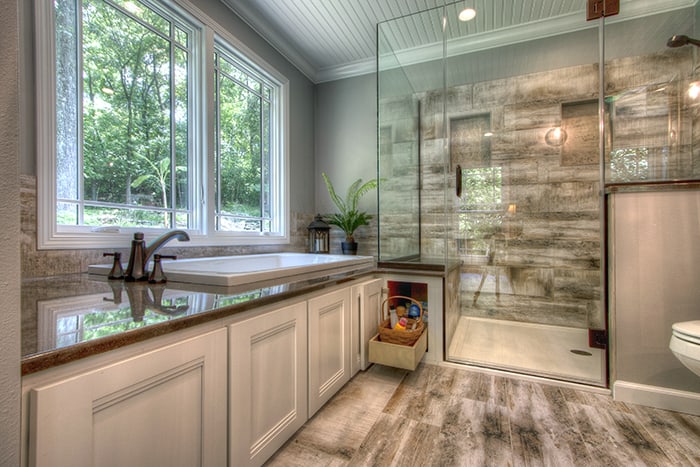



Intro to Accessible Bathroom Features
Thursday, July 21st, 2011The bathroom can be the first room to highlight decreasing mobility as we age. This is because it’s a room equipped for a wide range of purpose and movements. Should your bathroom present new challenges, an accessible bathroom canl increase your freedom and independence. Here is an introduction to some of the most useful accessibility features for the bathroom:
GRAB BARS
Bathrooms require much physical activity – sitting, standing and moving about on wet surfaces. All of these activities are easier and safer with grab bars.
Place grab bars next to toilets, and inside and next to bath tubs and showers. And they are now as beautiful as they are functional. Many bathroom lines now include grab bars with other bathroom accessories like towel racks and robe hooks, so they come in a large array of styles and finishes.
COMFORT-HEIGHT TOILETS
Make it easier to raise and lower yourself onto a toilet by increasing its height. Standard toilet height is 14 – 15” inches above the finished floor, while comfort-height toilets are 17 – 19” high. Those extra 3 – 5” inches of height can make a big difference with your knees, legs and balance.
Comfort-height toilets are quickly becoming a standard feature because they just make good sense, and now come in a wide variety of styles and colors to coordinate with most any bathroom interior design.
ROLL-UNDER SINK & VANITY
Clear floor space under a sink and vanity countertop creates room for a wheelchair, bench or chair. The recommended height for accessing a sink while seated is 34” maximum from the top of the counter to the floor, which needs a minimum clearance of 29” from the underside of the sink to the floor.
There is also the option of an adjustable sink that can be raised and lowered to the best height for the person using it. It can be operated manually or electronically with a remote control.
FAUCETS
Limited dexterity in your hands can easily be overcome with new sink fixtures. Single lever faucets operate with one hand and make it simple to adjust flow and temperature without using your fingers or wrist. There are also electronic faucets with sensors that detect when it’s time to turn the water off and on. They are very similar to ones you may have encountered in public restrooms, and while they are a bit more expensive, their total ease of use and water-saving efficiency makes them a good long-term investment.
LIGHTING
Aging eyes need plenty of light, so consider both overhead and task lighting for specific areas. Shower interiors with no windows can get pretty dark, which is a safety hazard; a waterproof light fixture inside the shower stall or above a tub and shower enclosure takes care of this problem.
Also keep in mind the light switches themselves. Moving switches to a lower spot on the wall makes them easy to reach from a seated position, and rocker-style switches make it simple to operate lights with the simple touch of a finger.
ACCESSIBLE SHOWERS
Removing the obstacle to getting into the shower is the goal of low-clearance or no-clearance shower. The roll-in version usually has three walls with one open side so a wheelchair can glide in, and the floor is sloped toward a drain flush with the surface. The walk-in version is essentially a four-sided box with a low-clearance threshold under the door.
BENCH SEATING
An important aspect of an accessible shower is a place to sit. For tighter spaces, a retractable bench can be mounted to the wall so it’s not in the way when not in use. If you’re opting for a complete remodel for an accessible shower, a built-in bench is a great option that benefits everyone who uses the shower.
HANDHELD SHOWERHEAD
Also known as hand showers, they have a hose attached to them so they can be removed from the wall and held in your hand. Some models are attached to a vertical bar so the height of the spigot can be adjusted for sitting or standing when used as a wall mount.
This is just a sample of the features that are available when remodeling your bathroom for accessibility. The Certified Aging In-Place Specialists (CAPS) at Mosby Building Arts are deeply experienced in accessible design (see their projects here) and will work with you on what options will be right for converting your bathroom for mobility. For ease of use in your bathroom, call the Mosby office at 314.909.1800 or contact them here.